http://aview.tv/the-strange-but-fortunate-tale-of-padstow-jack_d7a67b0da.html
Story
A film with a story
The Rocking Stone
On Cadair Idris, close by to the bottomless lake of Llyn Cau, I spent the night on a Rocking Stone, with a youthful desire in my heart, to be a Poet Bard. Legend has it that a night on Cadair’s cold flank gives the curse of madness, or the blessings of Seer or Bard. I knew the risk to my mind and the risks of the rocking stone, the balancing of the stone, a balance to be held on a dark night, high up and all alone. I sat and prayed in silence to the moon and stars above, looking up with eyes wide open, alert to the mountain, the rock and the wind that blew in that desolate spot.
The night was long. I came down with the dawn as nothing; an empty vessel waiting to be filled. No-one, nothing at all. Aware that I was very small.
Ten years later, or was it five, and does it matter how old I was, I spent the night on a rock atop a Tor, looking out across a wide open remote moor. I saw the creatures of the night as they scurried about and eyes shining and blinking in the dark. I heard the song of the wind through the rocks. Nothing more. It was enough.
The night was long. I came down feeling I belonged to something though I knew not what. I became a journey begun.
The night I spent on the cliff edge where the wind sings in the grass above granite rock, the waves beat on the rocks below and seven hours became one. Time slowed, or the stars and the moon sped by, who can tell which, the night I sat high on the cliff edge, the moon path spread across the sea, glimmering on water, reaching out to the a far horizon.
The stars, with the moon at the centre of all, moved in a slow ballet of curved motion across the sky, the constellations shone out from the web of night, a rotation eternal, a moving wheel. Beneath me the tide rolled in an out, fast. Time did not stop, it slowed or the world sped up while beauty shone out high above.
Seven hours became one.
If I can, by a shift of my mind, alter seven hours to one could I change one hour to seven and make life longer or can I pull seven hours into one? What is time but illusion? The days of a child are long, a summer an eternity. Seven hours could easily be as seven decades to a shorter lived creature than me. Does a butterfly live six score years and ten in so short a span as a day.
The earth is a rocking stone held in place by the moon while the sun brings it life. Time does not exist. Life and death is all we have and are but we are not bound in time.
We are all finely balanced on the stone. We either fall off or we balance.
This is all I have learned on the Rocking Stone. This is not the end of my journey, a journey I make alone.
Woops! Let’s go cavorting! (silly one)
woopie-doo-dah, doo-dah-day
let’s fly, and fly, fly far away,
over the hills, a far flung thing
who’s to reason or wonder why?
i see no reason here to stay
i can hear the fairies sing!
have you forgotten we once flew?
the hour is late but not too late
i have a wish for morning dew
and mountains high
and rushing rivers wide and deep
and the holy grass beneath my feet
deep in the woods
where the shadows play
come prepared
follow the hare
spin three times
bow to the moon
here comes the breeze
here comes the spin
whirling like leaves up to the sky
the wind that’s strong will lift us high
but don’t let it blow your top knot off!
The Book of Love & Imagination
A ballet (machinima) based around my poems.
Full credits are given on the link
The Blackbirds Mirror
Once upon a time and over the hills far away there lived a man of about thirty summers who, being orphaned at twelve, had spent much of his life travelling and finding work and shelter where he could. His name was Gwylym.
On the day that we join his journey he had come upon a beautiful orchard, just as the daylight began to fade. He decided to stay there for the night and rest. The orchard was on a hillside above a broad sweep of pasture and he sat for a while looking down, his eyes travelling across the curve of the land until in the distance he saw a bridge that spanned a small river and lead to a small castle. The evening sun tipped its many turrets and spires with pink and lilac. He decided to take the road across the bridge to the castle on the morrow, in the hope of finding a little work that might suit his skills.
He was awoken early by the dawn chorus, the air full of twittering and chirrups, but one voice rang out nearby and above them all, the persistent song of a Blackbird. In a half doze the young man listened to the voice and was convinced that the bird was trying to converse with him. He lay in his state of half-sleep, that place that always seems to hover between two worlds, and listened.
”Take apples. Eats, eat!” chirped the bird, ending with a shrill note.
”Take apples. Eats, eat! Take the perfect one, keep, keep!”
”Take the perfect apple. Pocket it. Pocket it!”
The bird repeated these phrases again and again between other messages the young man could not decipher. The bird made so many shrill cries that soon the traveller became fully awake and being hungry he did as he was bid. He considered the fact that this orchard was not wild and that the eating of the apples might be considered a theft but as he was hungry and had no other food but a crust he compromised and ate only a few. He hoped he might find some honest way to earn a meal at the castle.
In the centre of the orchard he discovered a tree a little larger and older than the rest. Hanging from a low branch was an apple so beautiful that it seemed to glow. Gwylym hardly dare touch it, yet he felt sure that it was the apple the blackbird told him to keep. He hesitated, unsure. Gwylym always did his best to be honest but choices are not always easy. He sat down to think. The blackbird appeared on the branch. It turned its bright eye upon him and nodded.
Gwylym looked at the bird wondering. Nothing is always as it seems. He felt instinctively that there was more to this bird than met the eye and wondered if it was to be trusted. This might be a trap. But Gwylym’s instincts and insights were generally good and he saw no harm in the eye of the bird or its demeanour. He smiled at the blackbird and stood up and gently plucked the apple from the tree. It looked very juicy and appealing. He was very tempted to take a bite but he put it in his pocket as he had been told.
Gwylym had no idea what all this meant and there was nothing to do but continue his journey. He slung his pack on his back and walked down the hill and crossed the river. He thought he saw the blackbird fly up to the battlements as he approached the castle. The drawbridge was raised and he couldn’t enter.
Up above on the battlements, out of his sight, a lady looked down on him. She had long dark hair that flew about in the wind and wore a dress of apple green. She narrowed her green eyes as she watched Gwylym and a blackbird came to rest upon her shoulder. The bird hopped down and a tall man appeared beside her wearing a long dark cloak clasped with a brooch like a birds wing. He put his arm around his Lady and called to a nearby guard to drop the drawbridge and go out and invite the young man they saw there to enter.
”I would like you to test this man,” the Lord said to his Lady, ”Along with the other six applicants who await us. I saw something in him. We need a judge who is a stranger in these lands and though all of these men are new comers, as is he, we need to look deeper into their characters rather than at their qualifications and connections.”
The Lady nodded, ”I will have them look in my mirror, my Lord.”
Gwylym was somewhat surprised to see the drawbridge lowered and an ornately dressed guard come out to greet him. The guards message that he had been invited inside for an interview with the Lord and Lady surprised him even more but he was glad to be welcomed and followed the guard to an antechamber that was richly decorated with tapestries of all kinds of birds and animals.
Six men were in the room, all finely dressed. Some looked very wealthy and some very studious. Some sat and spoke in low voices or fiddled with scrolls whilst other strolled about impatiently. Each of them bore a gift in his hand. Gwylym was puzzled as to why he found himself in such fine company, being rather shabbily dressed himself. It slightly alarmed him. He caught a few words here and there and realised that he was to be interviewed for the role of a Judge, for which he was not at all qualified. As he waited he decided he had better let this fact be known as soon as he had the opportunity. He would ask if they needed any carpenter or smith.
At that moment the anti-room doors were flung open wide and they were beckoned in to the inner chamber. The Lord walked forward to greet them. The Lady sat on a chair beside a mirror, covered over with a cloth of fine lace.
The Lord was most welcoming.
”Present yourselves to my Lady” he said, as he perched himself on the arm of a chair, where he sat idly swinging one leg. ”I am for the present only here to observe these proceedings.”
Each of the men approached the Lady and bowed and presented her with a gift. The gifts were very fine indeed and included jewels and finely crafted ornaments and a wondrously worked leather bound book on the tenets of the Law.
When Gwylym’s turn came he flushed with embarrassment. He stepped forward.
”My Lady I think there has been a huge mistake. I am a man only skilled with my hands. I have no legal qualifications or experience. I am sorry that I am taking up your time so unnecessarily.”
The Lady smiled. ”You speak well nonetheless” she said. ”Keep your place. You have a gift for me?”
This anticipated question had been worrying Gwylym. He had nothing of value in his pouch. All he could offer to a Lady was the apple in his pocket. He dare not part with the tools of his trade.
”I ask your forgiveness again my Lady for I have nothing to offer you but this apple and even that does not fully belong to me for it is from your own orchards. I have only carried it here. Perhaps it may refresh you.”
The Lady took the apple, glanced at her husband with a smile, and nodded to Gwylym. ”The apply will suffice.”
She turned to the assembled men.
”Gentlemen,” she said ”We have looked closely at all your experience and qualifications. We are eager to find a truly fair judge of our peoples. Please keep this matter of fairness and balance in mind. I have no questions to ask you but I ask each of you in turn to look in the mirror that stands beside me”
With that she pulled away the lace cloth and there stood a most unusual mirror set in an iron frame of blackbirds in flight, there wings overlapping each other.
The Lady gestured for the first man to step forward. His manner was relaxed as he stepped forward but when he looked in the mirror he took a sharp breath and stood transfixed. He put his hand to his face.
”This is not me,” he said. ”I don’t recognise this face though I see it is my own hand that touches it in the reflection. This is some magic to deceive me.”
”I assure you this is no deception,” said the Lord ”You may leave the chamber.”
The man could not hide his irritation as he swept from the room.
The reaction of the next man was much the same and the third said,
”This mirror is seriously distorted, twisted and fogged. I cannot see myself clearly.”
The Lady stood behind him and looked over his shoulder, ”You see my face Sir?” she said.
”Yes, my Lady,” he replied, ”I see your face clearly. If I may be permitted to say so you look just a little older and wiser in your reflection and with a clear beauty but my own face is distorted and unclear to me, if this be my face at all, which I doubt. I am greatly puzzled by this mirror.”
”You may leave with our thanks” said the Lord ”and be welcome to dine at our table later. At that time we will announce our choice to all.”
The man looked a little more hopeful and left the room.
The fourth man admitted to recognising his own face and claimed that the mirror was flawed. He was thanked and dismissed politely.
All took their turn with similar results. The Lady beckoned Gwylym forward.
Gwylym saw not his usual reflection but an image that seemed to him to go far deeper, a reflection of his inner being perhaps.
”What do you see Gwylym?” asked the Lady, noticing that he looked with great concentration but no bewilderment.
”I see that this mirror is not flawed,” Gwylym answered. ”It is crystal clear. It is me who is flawed and the mirror reflects this. Where there are distortions to my face, not revealed by any other mirror, I recognise each distortion as my own.”
”Explain them to me,” said the Lady, with an encouraging smile, and stood behind him to look. The Lord shifted on the arm of the chair and leaned forward to see.
Gwylym peered at himself closely.
”There is a darkening, a shadow, at the side of my left eye. I think that’s a blow I struck someone in unjustified anger. The line that runs to the right of my mouth are all the unkind words I now regret. My right eye looks far more closed than the other and that’s the lies I told and the secrets I kept to keep myself out of troubles instead of being totally honest.”
The Lord nodded, ”Go on. What more?”
”I have stolen when hungry, my Lord,” said Gwylym ”More than once. I see this written on my face too. And envy I suppressed.”
”Something more,” said the Lord. ”Speak out without fear. I see something else in this mirror, something you are trying to hide.”
Gwylym looked in his own eyes and mouth searching for something other than the one thing he presently didn’t want to admit. The Lord sighed.
”Come, come, speak up,” he smiled.
”My Lord. I am very attracted to your Lady who stands so close behind me.”
The Lord laughed, ”Yes, I see it. But what man would not be. You are forgiven whole heartedly. I would like to appoint you the Judge of this land, for a man who can see himself clearly can also see others and having flaws himself can be trusted to judge as fairly as is possible.”
‘’But my Lord,’’ Gwylym protested, ‘’I know nothing of the Law. I am a simple man. Please, if you will, give me some task so that I may serve you with skills I have.’’
‘’You will find that you are perfectly suited to the role Sir, for I see this in the mirror too and as to the Laws of our land they are really quite simple and are designed to protect and defend human virtues. You need not spend your days amongst dusty tomes I assure you. I will help and guide you if a case is more complex and you request it but it is you who will make the judgements and I will trust you that they be fair.’’
Gwylym felt reassured but not entirely convinced. He had begun to like this Lord and Lady and felt happy to do his best to serve them and so he inclined his head and said, ‘’I will do my best to be a fair Judge, my Lord.’’
The Lady smiled, ‘’that is all we ask. Come now let us dine and drink a cup to your future. ’’
Gwylym was the Judge in those lands for many years after and as his wisdom and experience increased he became known amongst the people as Gwylym the Wise and Gwylym the Fair. He married a talented seamstress and had six children. On Fridays, when the Court was closed, they always visited the orchards and Gwylym often made furniture while he pondered a difficult case. Those pieces that survive to this day are all marked by a hidden blackbird. He never saw the Mirror again but he did notice that the Lord and Lady kept themselves very much to themselves and seemed to age very little.
Gwylym was of a great age when he died and his passing was much grieved by the Lord and Lady and the people.
The Innocent Hare (a story for Halloween)
To begin……………
Let me tell you a bit about George Ingham.
George was a fine example indeed of the well-established Norman gentry who have been the masters of all in Britain since the time of William the Conqueror.
He lived in a beautiful mansion, of old, honey-coloured, weathered stone in a gentle hollow within the heart of the surrounding hills. It looked very romantic with its false crenelated walls and towers and deep sunk mullion windows with huge stone lintels, a little over grown with ivy.
All was surrounded by formal gardens, tended by a dozen or so gardeners. There was a small lake, where the obligatory swans glided, and an old mossy fountain below his bedroom window that lulled him to sleep at night. Georges’ window looked out over the acres of rolling hills and woodlands he would one day inherit.
George was the son of a wealthy Squire in the Cotswolds and the heir to his families’ large fortune. He had had all the usual education, suitable to his status, but the result was that he could only speak some Latin and all the rest had gone in one ear and out of the other.
Nonetheless he cut quite a dash on the hunting field and was excellent at all gentlemanly sports and this was the pinnacle of his education.
He was, in fact, similar to all his peers at that time, except that he used to read in his fathers library sometimes and dabbled in magic, or thought he did.
To be fair, it was not entirely his own fault that he knew almost nothing of real magic, as the books in his ancestors library were less well informed on the subject of magic and local lore than was his old nurse. Her family had lived far longer in these parts than his had but, to him, she was a simple country woman and he had forgotten her stories. It might have served his life better if he had remembered them.
He had read a little of a local legend about a magic hare that could grant three wishes. One could wonder what such a wealthy young man might wish for, but, distracted by the dinner gong, he had not read it all, nor considered his three desired wishes.
He had read just enough in the library to think himself wiser than his fellows but not enough to make him other than completely ignorant.
Perhaps the picture I have painted of George is a little unfair and I wouldn’t want you to be unsympathetic toward him. It wasn’t his fault that he was born into this idle and ignorant way of life and, besides that, he was good-humoured and handsome and generally kind to his horses and hounds and much-loved by the ladies of the area.
But enough about Georges attributes. We know him well enough now as he mounts his fine black horse to run with the fox hunt one fine early morning in autumn.
He presented a very fine figure indeed in his leather doublet, embroidered britches, silk shirt and scarlet jacket, as his horse stamped and pranced, impatient for the gallop, while he tossed back the stirrup cup. George was as eager for the chase as was his horse.
The hunt set off at a brisk trot down the gravelled path and out through the arched gateway into the open parklands, where they began a canter downhill, jumping fences, making a wonderful sight to the eye for those who were watching.
Then they paused and waited while the hounds whirled about seeking a scent. It was not long before they found one. The horn was sounded and they all swept on in a galloping flood after the hounds and the fox.
Before they had gone very far a hare, startled from the long grass, suddenly shot across George’s path and headed towards the woods at the side of the valley. With his head full of half formed facts George left the hunt and took off after it alone.
The hare ran ahead, plashing the dew up behind it, diamonds in sunshine, as it zig zagged back and forth ahead of him, its heart pounding. It gained the edge of the wood just ahead of George who went to follow, but, his horse reared and refused to enter.
George dismounted and tried to soothe the horse but it continued to rear, its hooves coming close to his head. He lost his grip on the rein and the horse bolted.
George was alone on the edge of the wood, with no horse and no sign of the hare. He stood there cursing that damn hare and the inclination that had made him follow it.
Then he heard something that sounded like fountains and gentle music from inside the wood. He had never entered there before but fountains and music seemed incongruous. He felt compelled to explore and find out.
George hadn’t gone very far when he heard another sound further away, as if blown on a breeze …….click click, click click.
He stopped to listen but it stopped when he stopped and he only heard fountains and music. He walked on, halting each time he heard it again, a hollow click click, click click, click click ……. and now the music had stopped. He stood turning about confused. The wood seemed to have darkened. No sunlight pierced the canopy overhead and the branches seemed to bend closer.
He felt a slight shiver run down his spine and, turning again, he caught a glimpse of something out of the corner of his eye. Or thought he did. He told himself he was imagining things. He peered through the trees. It must have been only a shadow, a trick of the light.
He decided to turn back.
When he looked behind him he couldn’t see the path. Brambles and nettles huddled up close and the thorns had already caught at his clothes. He pulled himself free and saw a wide, open, uphill path to his left. He followed it up hill and down, winding back on itself while the trees grew ever closer. Soon he was ducking under branches and stumbling over ancient gnarled roots. The twigs caught at his hair. All the time it was getting darker, until he could hardly see ahead
But there were lights. Bright cluster of sparkling lights of all colours far off between the trees and he heard whispers all around him.
”Look at his jacket. Its rags” they whispered.
”He is not a fine fellow now is he. Bring him this way.”
….and then soft, ringing laughter that tinkled like silver bells on a summer breeze.
Each time he stopped to get his breath back he heard it again – sinister – click click, … click click. It jangled his nerves and set his teeth on edge.
Click click, click, not metal, not wood, click
George looked around and again thought he saw a tall figure in grey. It was a woman. He thought she reached her hand out toward him but then she was gone. His imagination was fevered.
George was in panic. He waded through mud and lost his boots to escape sharp thorns. He fell on his knees at last. He prayed. He begged. He threw out wild promises.
Suddenly the trees drew back and a wide path opened before him and the sound of the fountain returned. He stood up eagerly and ran down the path, followed by more laughing merriment.
He heard a voice whisper ”Hush” and all was still.
George found himself in a hollow. There was a large dried up fountain, its base full of rotting leaves. He walked to the fountain and sat down on its rim, dreading the thought of leaving this clearing.
He heard a rustle and closer now came the sound ………click click, click click. The click had an almost musical quality, soft yet clear.
George began to feel strangely drowsy. The leaves round the fountain began to swirl around him. He reached out his hand to brush them aside as they rose and touched his face.
The leaves smothered him, dragging him to the ground. George clung to the earth trying to escape. More and more leaves came. He clawed at the ground. The earth opened up before him.
Out of the ground came a blue-black moving carpet, a gleaming swarm. Thousand upon thousand of determined tiny beetles scuttled like one creature all over George while he thrashed about in terror. They filled his mouth, his nose and his ears. George could not scream or breathe or hear.
Silently they consumed what remained of Georges clothes. They stripped him right down to the bare white bone and then were gone in the wink of an eye.
The lady in grey stepped into the clearing and bent down to study the bones. She studied one bone at a time, trailing her finger along the thigh bone, lifting a finger to flex it, stroking the rib under the place where the heart had been. She cupped George’s skull in her hand, looked long and deep into the empty eye sockets and smiled.
Tiny lights, little figures like moth with fluttering wings gathered around brushing against the bones as the lady lifted the skeleton gently into her arms and carried it out to the far edge of the wood.
Click click. Click click.
Many bones were carefully arranged in the tree branches there; they clicked and turned in the wind. By dawn George was hanging there too in pieces, adding his own special note to the bone chimes.
Click click. Click click. Clunk. Click click.
In the morning the hare, running by, paused and looked up at George a moment. He wiggled his nose and sniffed the air and looked to the edge of the wood where a lady stood in a long grey gown scattered with sparkling cobwebs and a silver circlet in her hair bound round with ivy. Her green slanted eyes shone with delight and her hair hung to her waist in thick wild tangled ropes. She stood resting with one hand on a tree trunk, watching the bones sway in the wind. She raised the other in tender greeting and blessing to the hare who turned and loped away.
The lady spread her gossamer wings and glided up and away into the treetops.

photo by Richard Steel
A Bards Tale
Long ago, well before this time, but when the world was even then already old, there was an ancient college high up on a mountain peak, well away from any city or village. It was a college of Druids. Some called them Alchemists and some called them Healers, some called them Seers and many called them Philosophers and indeed they were all of these things. They also acted as Judges when called upon to do so.
It was here that the Bards studied and received their training.
As some of you may already know the studies of the Druids are very long indeed and so it is with the Bards. This tale is about a young man, Alwyn, who had spent nineteen years in his studies to become a Bard.
He learned the natural sciences, logic, philosophy, mathematics, geometry, music, grammar and syntax, oratory, history, astronomy and navigation.
After ten years of these general studies he began to memorise the key features all of the known myths and much poetry and the arts of storytelling and all of the forms of poetry as well as the twenty four ancient forms and their uses and the secrets of Taliesin’s work and the truths of The Matter of Britain. He had learned how to make his own poetry sing with internal beauty and how to hurl a curse so fearful that it could stop an enemy in his tracks.
As you can tell he really had to work hard but he was happy to do so. A Bard was free to tell a tale and say what he liked in free speech wherever he went in those days. He was also a welcome messenger carrying news of what went on in the land. Alwyn regarded it all as a great privilege. He wanted to be nothing else and was aware that there is no end to learning.
So, time passed and after another nine years he had the ability to spin a myth into a good tale to speak with a fine harp accompaniment or to play a music to which no feet could be still at a village dance and compose a fine verse on demand, and beautiful poetry from his own heart and from seeing the essence of nature. He then was set a task, a question, to deepen his understanding of story and to send him journeying, out in the world.
He was to be a travelling Bard. He was too young, inexperienced and unknown to be a great Bard in a great Court for by then he was only six and twenty years on this earth. He was a Bard for the people. He was given a harp as the tool of his craft, a pair of good strong boots and a blue cloak against the cold.
When he set off it was autumn, just as it is now. He carried little, just a small bag of the most necessary things and a hip flask of mead. He took up his harp and slung it onto his shoulder and began his journey of a year and a day..
He descended the rocky path into the woods below. All the leaves on the trees shone with orange and gold and the woods were full of sounds as the creatures bustled about preparing their winter stores.
He thought of the myths and stories he knew and none seemed to fully answer…… ”What is honour?”
The young Bard realised that for all his studies he had less than he thought in his own store for he knew little of the outside world, least of all, about the question he had been asked and was, at that moment, pondering.
A year and a day to answer a question.
”What is honour?” —- the words turned over and over in his mind. He had entered the shelter of the college aged seven. He knew he was himself not qualified to answer the question so he resolved to ask where he could, as indeed he had been instructed to do.
He gathered food here and there as he walked and drank the fresh sparkling water of the mountain springs and composed a new tune in his head as he walked. The words for a song came to him easily but the nature of honour eluded him.
As the sun was beginning to sink he had reached a valley and in the soft curve at the bottom of the valley a small well kept cottage was nestled, by a still grey lake fringed with reeds. There were sheep in a nearby enclosure, bought in for safe keeping at dusk.
A small boy, unafraid, ran out of the cottage door to meet him. The young boy knew a Bard when he saw one and was excited at the prospect of a tale. The boy was soon followed by his father and mother who were friendly, open hearted folk who invited the young Bard to share their supper in return for a tale or two and they all soon sat down by the fire for a bowl of mutton stew.
The Bard introduced himself as Alwyn and told them many tales that night, tales chosen with care to suit his audience, tales that made them cry a little and laugh a lot. He understood his audience well enough from his studies and even more by watching the firelight and delight or sorrow in their eyes, falling or fading and flaring up just as the flames did in the hearth.
They all grew tired, and the boy was long asleep, lulled by the sound of the harp, so they gave Alwyn a bed for the night and in the morning, as he broke the nights fast with them he asked his question. The farmer looked ponderous but the boy swiftly and brightly piped up with an answer.
”If you have honour you don’t steal from your mother or father because they are the people who care for you most and gave you life.”
His mother and father nodded and smiled but his father, looking thoughtful, added,
”Aye but what if you’re starving and ain’t got no coin? then you can steal but from only the rich. I’d steal the kings rabbits out of the wood and mind I don’t get caught and still keep my honour I reckon. He would kill me for it if I was caught though. Remember that my boy! But he should not have let you starve in the first place, I say. Where is the honour in starving folk? Good question it is and I have answered with all I know of it. High born folk will have another opinion of honour i suppose but I think i am as honourable as they. I just know we have been lucky and not had to think about honour too much.”
The Mother spoke then.
” I say it’s being true to the people you love and giving kindness to strangers. If you don’t do that it doesn’t matter if you are honourable in some fine way or not! If you don’t do those two things you are just plain bad!”
Alwyn thanked them for their hospitality and he took up his harp and slung it onto his shoulder and travelled on his way.
He told many stories in his travels and asked the question many times but felt himself no nearer to any certain truth of the nature of honour at all and had formed no opinion of his own, except that it had something to do with kindness and honesty.
Time was passing swiftly.
One day Alwyn reached the walls of a town. The gate stood wide open, for this was a peaceful time, but it was still always guarded by men at arms. Alwyn noticed that a few of them, off duty, were sitting around a fire and he wandered over to ask if he might warm himself and tell them a tale.
He told them tales of glory and battles and heroism and of the crafty schemes of merchants and the witty jests of village landlords in taverns which delighted them. Then he asked them ”What is honour?”
They all answered much the same.
”I serve the Lord of this land and he serves the King. I made a vow to do so. I took an oath and to keep that oath is a matter of honour for me.”
”And what if he commands you to do something you think is clearly wrong?” asked Alwyn.
The most outspoken soldier paused in polishing his sword and answered, with a tone of annoyance, ”I must obey whether I like it or not. I took an oath. I am not an oath breaker! A man who breaks a seriously taken oath is a liar and a cheat and has no honour at all! My Lord must also keep his oath to the King. We are equal in that.”
”And the King? Does he take an oath?” Alwyn asked.
”Of course!” said the Knight. ”He makes an oath to God!”
”He must claim to know very precisely Gods Will?”
The Knight gave the Bard a narrow eyed look and said, ‘I don’t question that. It’s not my place. I know what honour is and I live by mine.”
”You make it seem so simple” said Alwyn, with a smile, ‘Thank you.”
If Alwyn had not safe passage and free speech by right in the land it might have gone ill for him to be asking such a question about the King, but, as always, he took up his harp and slung it onto his shoulder and travelled on his way.
One day, as the first snows were beginning to fall and the red berries shone out against the dark leaves of the holly, he met an old man with a donkey, sheltering at the side of the road, huddled up against the chill air and stirring a pot of thin soup. He invited Alwyn to share his meagre meal which had a wonderful scent of herbs about it, rising in steam in the frosty air.
Alwyn felt sure, that being older in years than other people he had asked, this man might have a good answer. When he heard the question the old man nodded sagely and admitted it was by no means an easy question.
”I wrote a verse of my own about this,” he said. ”It does not answer your question but it does warn of Honour’s most dangerous companion …..
”Honour’s not without grave risks, you will see,
Since close beside Honour’s throne sits Pride;
And Pride’s self-gazing shatters love inside
The soul, thus leaving naught but echoed “Me!”
So heed my paltry lines I write: Stand tall
When called before the crowd, a hero’s crown
Receiving. Wait, when you take it for your own
and know, Pride goes forth before a fall.”
At this moment a younger man came out of a nearby wood, attracted by the fire. He was simply dressed but he had a very fine horse and the horse wore armour and its reins were held by a squire. The man was very polite in his manner. His hair was turning just a little grey and he looked tired and care worn. The old man stood and bowed stiffly and invited him to rest at the fire. Alwyn greeted him with a smile.
”I could not help but overhear your verse” said the Knight, for such he was. He took a seat on a moss covered stone near the fire.
”We were discussing the nature of honour Sir” said Alwyn, passing the Knight and the old man a cup each of mead from his flask. ”May we have your own opinion?”
”Indeed” said the Knight,, ”for honour is the core at the heart of my life. It’s a continuous reaching for a better version of ourselves, and encouraging others to reach for that also. It’s a way of relating to others that places them not only higher than ourselves, but higher than they might think of themselves. It is a standard that we must reach, or die trying, because anything less would be a failure of character.”
”A very interesting answer Sir,” said Alwyn, thinking it the best answer he had received so far and that it seemed to fit well with what the farmers wife had said.
Wrapping his blue wool cloak close around him and bidding them farewell with blessings Alwyn slung his harp on his back and travelled on, thinking of the Knights words about having a better self. What was this better self we much reach for?
The end of Alywn’s journey had arrived and he was still pondering this question as he arrived back at the door of the college. The year and a day was over and even before he had unslung his harp from his back he was called to his teachers chamber to give his own answer and this is what he said,
”I asked many people and everyone answered me in accordance with their view of the world and their own heart. It seems there always has to be a judgement made about what is honourable and what is not. Opinion may change with experience but you have to make these judgements every day of your life, even in the simplest act. I think it is a question with no certain answer and this is not a matter for dogma, for each mans life is his own responsibility. I think one aspect is based on kindness, for we all live in community, but one man spoke of his ‘better self’, a higher version of his self, and this I think is the clue. This higher self is the soul. Perhaps honour is the way we protect our own soul in all our own actions and sometimes we fail and sometimes we succeed but the honour is in the trying to care for our own soul. It is our soul that demands honour.”
The Druid smiled and told Alwyn to go and rest but Alwyn was still curious.
”Did I answer rightly?”
”Let your own soul answer that question and soon we will set you another for your next journey. Those who ponder on such questions as what is honour, what is truth and what is love and think with an open heart and mind are well begun in the journey of learning that will one day leads them to wisdom. Always take care of your soul. You will continue to travel. Your studies progress well enough.”
Birds
so much is shared through migrations
like birds dropping seeds as they fly
some cultures will grow and flourish,
some seeds will wither and die
looking back on history
and the incessant weave of the world
i see patterns intertwined, growing
interchange of art and design
leaves that bud from one tree
the branching of language and speech
a map of where we’ve all been
it says nothing of where we are going
in this we know less than the birds
Writing fantasy
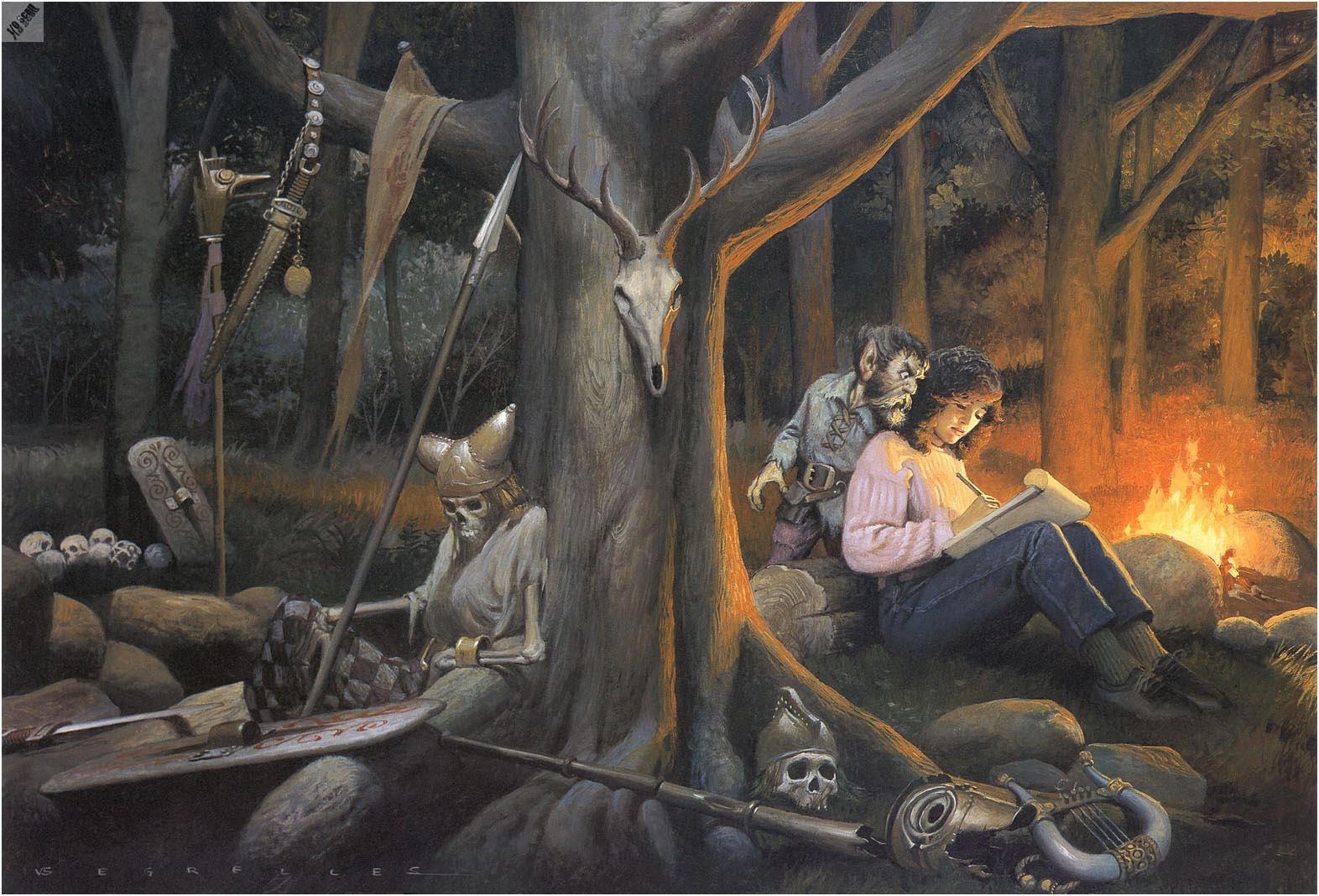
sitting in a room
the room becomes a wood
a wood i know so well
a vague story in my mind
the vision of a path
music and hushed sounds
i light the fire
invite them
i will sit and wait
until they gather round
whispering their tales
taking me to places
i never planned to go
 The Dreaming Path